Friday, May 30, 2014

Albert Kahn Museum and Garden

This afternoon we took the line 10 metro out to the end of the line to visit the  
 Most of my text is Wikipedia.
Albert Kahn (3 March 1860 - 14 November 1940) was a French banker and philanthropist, known for initiating The Archives of the Planet, a vast photographical project. Spanning 22 years, it resulted in a collection of 72,000 colour photographs and 183,000 meters of film.

Kahn grew up Jewish in Alsace.  A big part of the French Jewish population lived in that area at the time.  Kahn's mother died when he was ten and a year later, when Alsace was annexed by the Germans, and the Kahn family moved to France.
 
In 1879. Kahn became a bank clerk in Paris, but studied for a degree in the evenings. In 1892 Kahn became a principal associate of the Goudchaux Bank, which was regarded as one of most important financial houses of Europe. He also promoted education at the highest level through travelling scholarships.
 The Garden of the Worlds (French: Les Jardins du Monde) In 1893 Kahn acquired a large property in Boulogne-Billancourt, where he established a unique garden containing a variety of garden styles including English, Japanese, a rose garden and a conifer wood. This became a meeting place for French and European intelligentsia until the 1930s when due to the Crash of 1929, Kahn became bankrupt. At that time the garden was turned into a public park in which Kahn would still take walks. The garden brings together distinct traditions (French, English, Japanese), as if to illustrate the utopia of a world reconciled, where different realities can coexist in perfect harmony.
 Kahn considered himself an internationalist and a pacifist.  He was a very wealthy man and a very generous philanthropist.  By some, he was thought to be rather odd because of his habits.  He exercised and showered almost daily and was a vegetarian. 


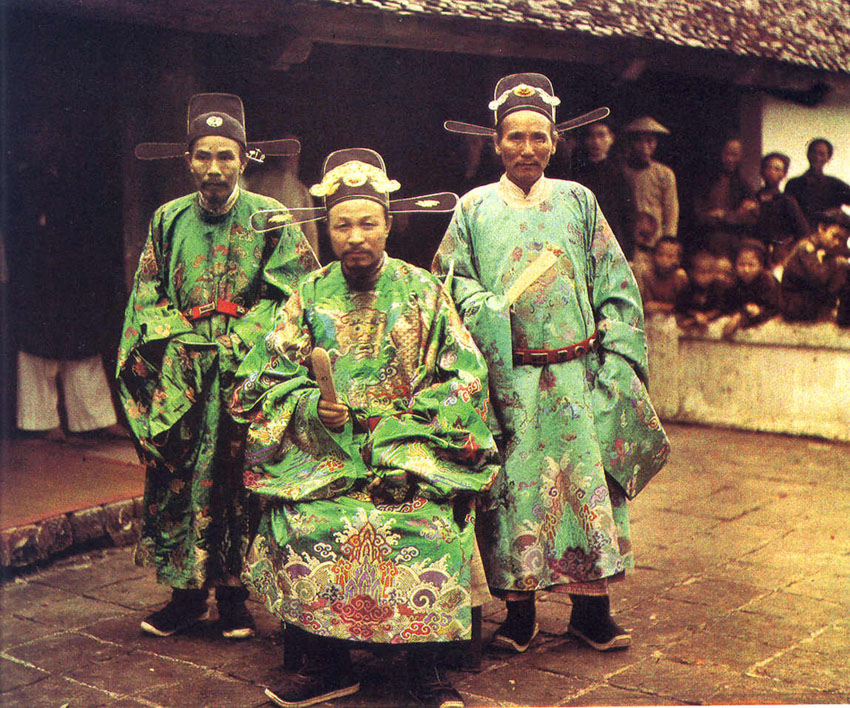
In 1909, Kahn travelled with his chauffeur and photographer, Alfred Dutertre to Japan on business and returned with many photographs of the journey. This prompted him to begin a project collecting a photographic record of the entire Earth. He appointed Jean Brunhes as the project director, and sent photographers to every continent to record images of the planet using the first colour photography, autochrome plates, and early cinematography. Between 1909 and 1931 they collected 72,000 colour photographs and 183,000 meters of film. These form a unique historical record of 50 countries, known as The Archives of the Planet

Kahn's photographers began documenting France in 1914, just days before the outbreak of World War I, and by liaising with the military managed to record both the devastation of war, and the struggle to continue everyday life and agricultural work.

BBC put out a coffee table book with some of the photos. 
 
Here are a few more examples from the museum's collection.  The photos and films on display at the museum seem almost other worldly because it is so strange to see things from that time in such bright color.

Throwing Sticks and Petting Fish


 Thursday the girls celebrated Ascension by having a another day off of school.  I recently found a fake, and therefore cheap, game of Mölkky at our nearest sports store.  We headed over to Place de Georges Guillaumin, which is also the garden of Salomon de Rothschild's mansion.  This is where in 1932, French President Paul Doumer was shot and killed.
 Lillian won the game!  Pierre and I lost and Sylvia cheered us all on.
 Solomon de Rothschild's mansion
    We had lunch at Dragons Elysées, which is right off of the Champs Elysées.  If you are looking for good food, you should go elsewhere.  If you want to dine where there are carp swimming under your feet and where you are surrounded by aquariums, this is your place. Also, you can kneel near the fountain and pet the carp while you wait for your food to arrive. There were lots of families enjoying their holiday.
Pierre and I also checked out this place.  Napoleon was in Egypt from May 1798 until the end of 1799.  In 1799, this building was erected at Place du Caire.  These heads are enormous and I think the Yoda ears must be flowers.  The hieroglyphics are created from the French imagination.  The building itself is quite pretty.

Wednesday, May 28, 2014

Clemenceau at Musée Guimet

Pierre and I went to an exhibit about Georges Clemenceau.
Georges Benjamin Clemenceau (28 September 1841 – 24 November 1929) was a French statesman who led the nation in the First World War. A leader of the Radical Party, he played a central role in politics during the Third Republic. Clemenceau served as the Prime Minister of France from 1906 to 1909, and again from 1917 to 1920. He was one of the principal architects of the Treaty of Versailles at the Paris Peace Conference of 1919. Nicknamed "Père la Victoire" (Father Victory) or "Le Tigre" (The Tiger),

Clemenceau was a fascinating man and I am sure my Grandpa Brown would have had a thing or two to say about him.
In Paris, the young Clemenceau became a political activist and writer. In December 1861, he co-founded a weekly newsletter, Le Travail, along with some friends. On 23 February 1862, he was arrested by the police for having placed posters summoning a demonstration. He spent 77 days in the Mazas Prison.
He graduated as a doctor on 13 May 1865, founded several literary magazines, and wrote many articles, most of which attacked the imperial regime of Napoleon III. Clemenceau left France for the United States when the Imperial agents began cracking down on dissidents, sending most of them to the bagne de Cayennes (Devil's Island Penal System) in French Guiana.
Clemenceau worked in New York City 1865-69, following the American Civil War. He maintained a medical office but spent much of his time on political journalism for a Parisian newspaper. He took a post teaching French and horseback riding at a private girls' school in Stamford, Connecticut.

And that was all before he became prime minister.
Clemenceau collected boxes that were used in Japanese tea ceremonies.  He was also involved in creating Musée d'Ennery and Musée Guimet.  He also had a few netsuke.

In 1891, Clemenceau took part in a Buddhist ceremony in the library of the Musée Guimet.

Collectors of the time published large vanity catalogues to show everyone what they owned.  
Clemenceau was right in the middle of "le japonisme" and admired and collected Asian art .  However, his interest went beyone art and collecting.
After he retired, he travelled extensively in Asia.
Le Jardin d e Clemenceau by Blanche Hoschedé-Monet (Monet's pupil and step-daughter)
Clemenceau was good friends with Monet.  It was Clemenceau's idea to have Monet paint the enormous waterlily paintings that are now in Musée de l'Orangerie.
His house, which is in our neighborhood, has been turned into a museum.  Pierre has visited, but I have not yet been.

Tuesday, May 27, 2014

Things we did in May


 There is a tennis ball hanging from the Eiffel Tower!  It is French Open time. 
 This guy is done riding a Velib' to work and is now riding even more interesting places.
 If you have talked to me in the last couple of years, I have probably mentioned the book The Hare with the Amber Eyes: a Hidden Inheritance by Edmund de Waal.  I mentioned the book before here and probably elsewhere on this blog.  I finally made it to the Ephrussi house over near Parc Monceau.
 Hôtel Ephrussi at 81 Rue Monceau
Excerpt from Hare with the Amber Eyes:
If this particular house in this particular streetscape seems a little stagey, it is because it is a staging of intent. These houses in Paris and Vienna were part of a family plan: the Ephrussi family was ‘doing a Rothschild’. Just as the Rothschilds had sent their sons and daughters out from Frankfurt at the start of the nineteenth century to colonise European capital cities, so the Abraham of my family, Charles Joachim Ephrussi, had masterminded this expansion from Odessa in the 1850s. A true patriarch, he had two sons from his first marriage, Ignace and Léon. And then when he remarried at fifty he had continued producing children: two more sons, Michel and Maurice, and two daughters, Thérèse and Marie. All of these six children were to be deployed as financiers or married into suitable Jewish dynasties....
By 1860 the family had become the greatest grain-exporters in the world. In Paris, James de Rothschild was known as the le Roi des Juifs, the King of the Jews. The Ephrussi were les Rois de Blé, the Kings of Grain. They were Jews with their own coat of arms: an ear of corn and a heraldic boat with three masts and full sails. Their motto, Quod honestum, unfurled below the ship: We are above reproach. You can trust us....

Another day, Pierre and I went to Musée Guimet to see the Clemenceau exhibit.  While we were there we wandered through the permanent exhibit.  Musée Guimet is France's Asian Museum and has an incredible collection. 
 1st century blown glass fish from Afghanistan!  These museums blow my mind!
  
At the top of the museum there was a temporary installation.

Fête des Mères et Fête de la Nature

  Sunday was Mother's Day in France.  I was well spoiled.  I am very happy to be part of this strange and fabulous family.  How I am suddenly a mother to an eight year old and someone, "who is nearly a decade," is beyond me.
 Saturday we headed across town to Jardin des Plantes and the Fête de la Nature.
There were tents set up in the garden and various students and enthusiasts were leading activities about plants and animals.  The tents were needed because about every twenty minutes it would pour rain for five minutes.  Here the girls are playing a game and learning about bees.
 The flowers like the rain and the gardens are lovely.
 These look like a metallic sculpture.


 We then went inside the museum and visited La Nuit, a visiting exhibit.  It was well done and we enjoyed ourselves.  Here Lil is in front of the owl exhibit.  Night is dark, so my photo is not too great.


Paris is pushing its tap water by giving it away!

Monday, May 26, 2014

Memorial Day

 The American Girl Scouts in Paris were invited to put flowers on the gave of the unknown soldier under the l'Arc de Triomphe.  They followed bagpipers up a few blocks of the Champs Elysées, took the tunnel under the street, and arrived under the Arc.  The Arc was closed to tourists for Memorial Day.  They were not sure what to do with the parents, so we were invited to follow the girls and to watch the ceremony.  Most of these photos were taken by a girl scout mom with a nice camera.


 The girls each put a white rose on the grave of the unknown soldier.


The girls and I watched some videos online about memorial day to prepare.  I am grateful for all veterans and I am proud and grateful to be an American/Canadian.  
The girls did a great job and I am proud of them!